
Poker Trainer - Learn poker
Poker TrainerCard
4.481.00 Reviews
- Version
- 4.6.6
- Installs
- 100.00K
- Age Rating
- Teen
Screenshots
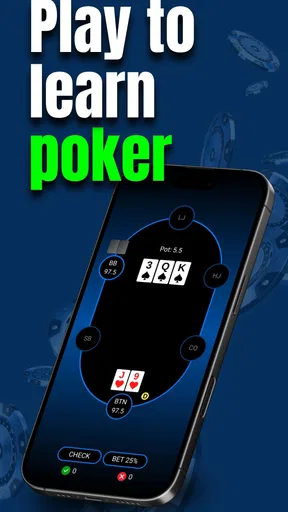
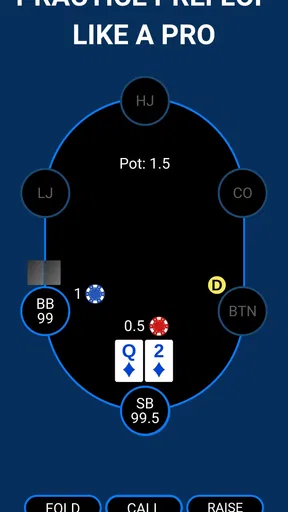
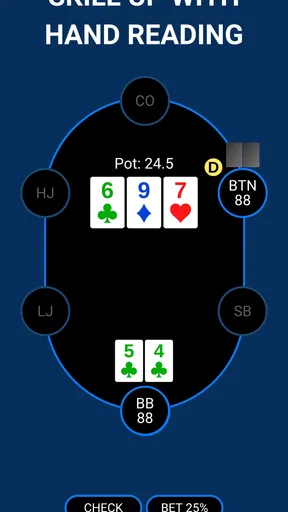
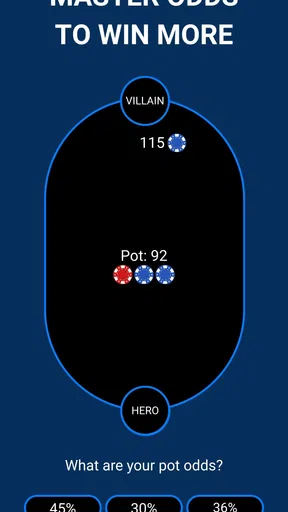
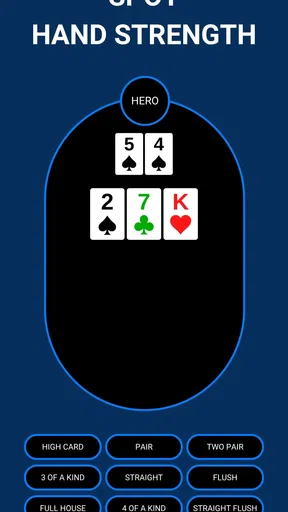
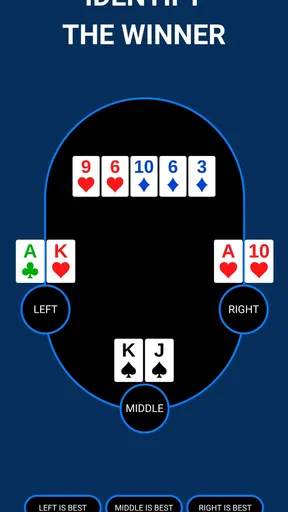
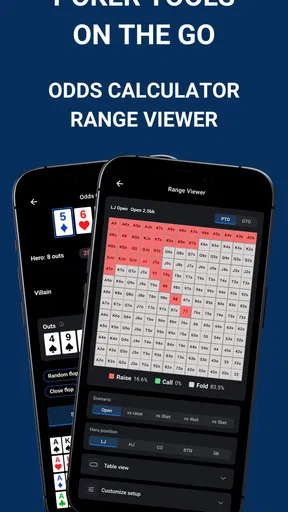
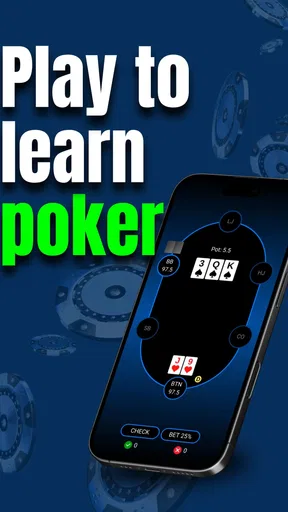
Our Review of Poker Trainer - Learn poker
 Analysis by Appyee
I approached Poker Trainer - Learn poker less like a traditional card game and more like a pocket study partner. Its purpose is clear from the first session: it is built for practicing poker decisions, not for recreating the social table experience with animated opponents, a dramatic casino setting, or a long campaign. That focus gives it a useful identity, especially for someone who wants to turn spare minutes into deliberate practice.
The app comes from Poker Trainer and sits in the card-game category. It is free to install, carries a Teen content rating, and has reached over one hundred thousand installs. Its average rating is 4.4 from around two thousand six hundred ratings, which matches my general impression: this is a focused tool that appeals strongly to learners, although it is not designed to entertain every kind of poker fan.
My first reaction was that the experience is intentionally restrained. The presentation does not try to distract me from the decision in front of me. Instead, the app puts the training task first, making it easier to concentrate on choices, patterns, and mistakes. That can feel plain if I am looking for the excitement of a live poker table, but it becomes a strength when I want a short, repeatable practice session.
How the app turns poker study into a playable routine
I use Poker Trainer as a compact study routine rather than a substitute for playing: a few focused decisions can make a spare moment feel purposeful, especially when I choose one habit to watch instead of chasing a perfect score. That approach also makes it easier to judge what the practice can—and cannot—teach, which is where the app’s most meaningful trade-offs come into view.
A focused first impression for learners
The most useful way to understand this game is to treat each exercise as a small decision laboratory. I am not opening it to bluff a human opponent, manage a tournament stack, or enjoy a cinematic poker story. I am opening it to test whether my response to a situation is strategically sound. That distinction matters because it sets the right expectations before downloading.
The beginner-friendly approach makes the app approachable even if poker theory still feels intimidating. Rather than demanding that I already understand every technical term, it gives practice a more manageable shape. I can focus on the decision itself and gradually become more comfortable with the reasoning behind it. For a new player, that is less overwhelming than jumping directly into a crowded online table where every mistake can feel expensive or embarrassing.
I also like the offline orientation. It makes the app suitable for moments when I do not want to depend on a live game, a stable connection, or other players being available. A short session while commuting, waiting for an appointment, or sitting away from home can become useful study time. The trade-off is that offline practice cannot reproduce the pressure, unpredictability, and social reading involved in a real poker game.
One practical habit improved my sessions: I stopped treating every exercise as a score to protect. Instead, I chose one idea to observe before starting, such as whether I was folding too cautiously or calling too often. That changed the app from a quick-answer quiz into a diagnostic tool. The result was more valuable because I could connect an incorrect choice to a recurring habit rather than simply moving on.
A visual language that keeps the decision central
The visual direction serves the training purpose by keeping attention on the cards and the choice. I do not get the sense that the interface is trying to build a large fictional world around poker. Its world is the decision space itself: a compact environment where the important information is presented for consideration. That makes the mood practical and study-oriented rather than luxurious, competitive, or theatrical.
This restraint is helpful when I am using the app repeatedly. Busy decoration can make a first launch feel impressive, but it can also become tiring during repeated drills. Here, the controlled presentation supports a rhythm of reading, deciding, checking, and reflecting. I can return to the same kind of exercise without feeling that the interface is competing with the lesson.
There is also a subtle difference between learning poker concepts and memorizing button positions. A clean presentation gives me room to ask why an action makes sense. I can pause mentally before selecting an answer, compare the situation with something I have seen before, and use the result to refine my understanding. That is where the app feels more useful than a casual poker game that rewards quick reactions without explaining the strategic structure.
Still, this visual simplicity will not satisfy everyone. Players who want animated chips, expressive opponents, themed tables, or a sense of place will probably find the experience too functional. The app’s setting is not a casino, a tournament arena, or a narrative world. It is a training desk. I consider that a fair trade, but it is important to know before expecting a conventional poker game.
Sound, silence, and the pace of practice
The overall rhythm feels more important here than spectacle. A good training session depends on a steady loop: inspect the situation, make a choice, understand the outcome, and continue. That pacing suits short bursts of concentration. I can complete a few exercises when I have limited time, or stay longer when I am actively working on a weakness.
The restrained mood also means the app does not lean on the emotional highs and lows of a casino-style production. There is no need for a dramatic buildup before every decision because the educational value comes from the reasoning. For me, that made the experience easier to repeat. I was less likely to rush simply because the presentation was pushing me toward excitement.
On the other hand, the same calm rhythm can become dry if I expect constant stimulation. This is not the right choice for someone who wants poker as a relaxing visual pastime or a social soundscape. It works best when I arrive with a small objective. For example, I might use one session to examine marginal hands and another to notice how often I act automatically. Giving the practice a theme prevents the repetition from feeling empty.
A useful workflow is to answer first without immediately trying to justify the choice with complicated theory. After seeing the result, I ask myself what information actually changed the decision: position, hand strength, the likely range, or the cost of continuing. This keeps the pace active while adding reflection. It also prevents a common mistake in training apps, where I recognize the correct answer but never understand the reason.
Where the mechanics fit real poker study
The central mechanic is decision practice, and that makes the game especially suitable for players who want a structured introduction to GTO-oriented thinking. The idea is not simply to follow instinct. It is to compare my first impulse with a more disciplined approach and become aware of situations where an apparently attractive action may not be the best long-term choice.
I found the beginner-friendly design most useful when I separated learning from performance. If I tried to get every answer right, I became tense and started guessing based on what I thought the app wanted. If I treated each exercise as feedback, I could notice patterns in my own thinking. That is a non-obvious strength: the value is not limited to the correct response; it is also in exposing how quickly I make assumptions.
The app works well as a supplement to playing, not as a complete replacement for playing. A drill can help me recognize a strategic shape, but a live table adds changing opponents, time pressure, incomplete information, emotional control, and bankroll decisions. Someone who only practices in a controlled environment may understand principles yet struggle to apply them when the pace becomes uncomfortable.
For that reason, I would use the app before and after real sessions. Before playing, a short practice block can put strategic thinking into focus. Afterward, I can revisit decisions that felt uncertain and see whether my instincts were consistent. I would not assume that a good result in the trainer automatically proves that I played well at the table; the two environments test different skills.
Another trade-off concerns depth. The app is accessible because it does not force a complete poker course onto the user at once. That makes it friendly for beginners, but a serious intermediate player may eventually want more detailed study material, hand-history review, opponent analysis, or broader explanations. In that situation, a dedicated poker course, database tool, or coaching resource may be a better primary choice, while this remains useful for quick repetition.
Who will get the most from it
I would recommend it to a new poker player who wants a low-pressure way to practice decisions before risking money or entering competitive games. It is also a good fit for a casual player who knows the basic rules but notices that instinct alone is producing inconsistent results. The short, focused format makes it easier to build a routine than a large learning platform that demands long study sessions.
It can also help players who already have experience but want to identify leaks in their thinking. The key is to use it deliberately rather than expecting the app to diagnose everything automatically. Keep a simple note after a session: which type of decision caused hesitation, what answer felt natural, and whether the explanation changed your view. That turns repeated drills into a personal study record.
A realistic everyday example would be a player who has ten minutes before leaving for work. Instead of opening a full online table and feeling pressured to stay, the player runs a small set of practice situations, focuses on one recurring mistake, and stops while the lesson is still clear. Later, after playing with friends, the same person returns to the trainer to examine whether a familiar situation was handled thoughtfully or impulsively.
I would be less enthusiastic about it for someone seeking multiplayer entertainment, a realistic casino simulation, or a game with a strong story and visual progression. It is also not ideal as the only resource for a player preparing for high-level competition. Its strength is accessibility and repetition, not the complete emotional and analytical complexity of poker.
Free access and the cost question
The free entry point lowers the barrier to trying the training approach. That is valuable because poker study is easier to judge after experiencing the decision loop than by reading a description. I could see quickly whether I enjoyed this kind of practice or preferred learning through videos, books, live play, or coaching.
There are in-app purchases ranging from $6.99 to $249.99 per item. That is a wide range, so I would advise new users to begin with the free experience and decide whether the app’s method genuinely fits their goals before spending anything. A purchase can make sense for a committed learner who uses the trainer regularly, but it is harder to justify for someone who opens it only occasionally.
The important question is not whether paid access exists; it is whether the practice changes my decisions at the table. I would look for evidence in my own routine: am I recognizing situations faster, questioning automatic calls, and reviewing mistakes more honestly? If the answer is no, buying more material will not solve the underlying problem. If the answer is yes, the app may be earning a place alongside other study tools.
Device expectations and long-term use
The current version is 4.6.6 and supports devices running at least Android 7.0. That makes the compatibility requirement relatively approachable for many Android users, although anyone with an older device should check the system version before planning a regular study routine. The app’s value does not depend on owning a powerful phone; its purpose is practice, not graphical spectacle.
Because it is a card-focused training game, storage and visual performance are not the reasons to choose it. The real question is whether the interface makes it easy for me to return, concentrate, and learn from decisions. I would rather have a modest-looking trainer that I actually use several times a week than an impressive poker game that I open only when I want entertainment.
Long-term usefulness depends on avoiding passive repetition. If I tap through exercises without considering the reasoning, the sessions become a memory test. I get more from it when I vary the context of use: one session for learning, one for checking instincts, and one for reviewing situations that appeared during real play. That rotation keeps the tool connected to actual improvement.
My atmosphere verdict
What makes this game coherent is the agreement between its mood and its mechanics. The quiet, practical presentation supports concentration; the compact card setting keeps the subject clear; and the measured rhythm encourages repeated decisions instead of dramatic spectacle. Nothing about the experience needs to pretend that it is a full casino simulation. It knows that its playable space is the moment before a poker action.
That coherence is also why its limitations are easy to understand. The app will not replace live opponents, table pressure, emotional discipline, or a complete poker education. It may feel too plain for players who want a richly presented game. But for someone who wants to practice offline, build confidence, and develop a more deliberate way of thinking, the focused design is a genuine advantage.
After using it, I would describe Poker Trainer as a practical companion rather than a complete destination. I would install it for short study sessions, use it to challenge my first instincts, and pair it with real play or deeper educational material. The best reason to try it is not the promise of instant mastery; it is the chance to make poker practice more regular and less intimidating.
My recommendation is straightforward: choose it if you want accessible, repeatable decision training and are comfortable with a calm, functional atmosphere. Skip it if your priority is multiplayer action, casino presentation, or a full strategic curriculum in one place. Used with realistic expectations, it gives beginners a sensible starting point and gives experienced casual players a convenient way to keep their thinking sharp.
Verdict
Strengths of Poker Trainer - Learn poker
- Covers Texas Hold’em rules, hand rankings, and core strategy concepts.
- Practice mode lets beginners learn without risking real money.
- Interactive drills help improve decision-making and hand recognition.
- Useful for reviewing poker basics during short spare-time sessions.
- Simple interface makes the lessons approachable for new players.
Limitations of Poker Trainer - Learn poker
- Advanced players may find the training material too basic.
- Does not fully recreate the pressure of playing at a real table.
- Some features or lessons may require in-app purchases.
- Practice scenarios may not cover every unusual poker situation.
- Progress can feel repetitive after completing the main exercises.
Similar Picks in This Category
View All
Solitaire - Classic Card Games
MobilityWare4.6

UNO!™
Mattel163 Limited4.3

Spider Solitaire: Card Games
MobilityWare4.6

Solitaire.com - Classic Cards
Tripledot Studios Limited4.7

Plants vs. Zombies™ Heroes
ELECTRONIC ARTS4.1

Hearthstone
Blizzard Entertainment, Inc.4.1
Frequently Asked Questions
What is Poker Trainer - Learn poker, and who is it designed for?
Poker Trainer - Learn poker is an educational app for people who want to understand and improve their poker skills. It is mainly aimed at beginners, although more experienced players can also use it to review fundamentals such as hand rankings, poker terminology, betting decisions, and basic strategy. The training format makes it useful for learning at your own pace rather than playing at a real-money table.
Can I play real-money poker or compete against other players in the app?
Poker Trainer - Learn poker should be treated as a learning and practice tool, not as a real-money gambling platform. Its purpose is to help users study poker concepts and make better decisions through lessons, examples, quizzes, or simulated situations. Before downloading, users should check the current app description and permissions to confirm whether any online multiplayer features are included, since available modes may vary by version and device.
Does Poker Trainer - Learn poker explain poker rules and hand rankings clearly?
The app is intended to introduce the essential rules needed to play poker, including the order of hand rankings and the meaning of common actions such as checking, calling, raising, folding, and going all-in. It can be particularly helpful for users who are confused by poker terminology. However, learning the rules is only the first step; users should also practice interpreting position, opponents’ actions, pot odds, and risk before relying on the app alone.
Is Poker Trainer - Learn poker suitable for complete beginners?
Yes, the app can be a convenient starting point for complete beginners because it allows them to study poker concepts without the pressure of a live table. New players can use it to memorize hand strengths, understand basic betting rounds, and test their knowledge through practice scenarios. Beginners should still read each explanation carefully and repeat exercises, because quickly guessing answers may create a false sense of confidence.
Does Poker Trainer - Learn poker require an internet connection or contain in-app purchases?
Internet requirements and pricing can depend on the version of Poker Trainer - Learn poker installed and the platform being used. Some educational content may work offline, while updates, advertisements, account features, or additional lessons may require a connection. The app may also offer optional purchases or premium content. Check the Google Play Store or Apple App Store listing for the latest information about subscriptions, ads, supported devices, and privacy permissions before downloading.
Play our best games!


